





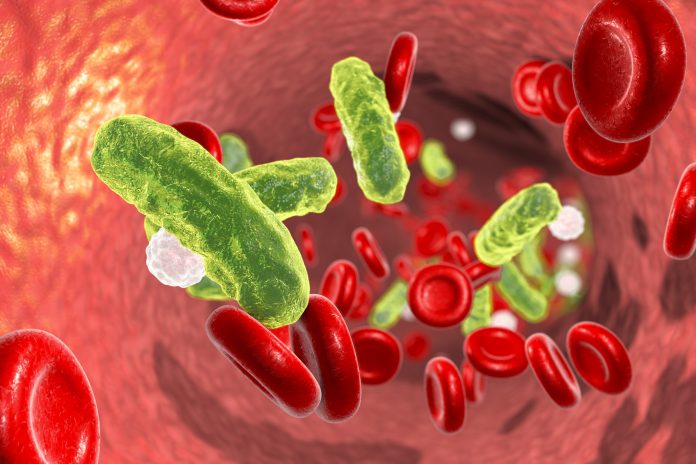
Scientists have developed a new method to comprehensively diagnose bloodstream infections and sepsis in as little as seven hours, according to a study published today in Science Advances. The test combines single-cell analysis with molecular barcoding to identify pathogens at very low concentrations and determine which antibiotics are most effective against them.
“Using single-cell analysis technologies developed by our team, we can accurately identify pathogens in blood even when they are present at very low concentrations,” said Pak Kin Wong, PhD, professor of biomedical engineering and mechanical engineering at Pennsylvania State University. “Identifying the pathogen alone is not enough; we must also determine which antibiotics are effective against it. This led us to integrate antibiotic susceptibility testing into the same process, providing physicians with the information needed to select the most appropriate treatment.”
Bloodstream infections often progress to sepsis, causing systemic inflammation and organ failure, and accounting for about a third of all hospital deaths. Despite the severity of the condition, the gold standard method to diagnose sepsis takes between two to seven days to identify the bacteria causing the infection. While early initiation of the right treatment is critical for patient survival, receiving an inappropriate treatment can increase the risk of death. However, clinicians must often resort to broad-spectrum antibiotics before the causative bacteria are identified, as waiting for a definitive diagnosis can delay potentially life-saving treatment.
“For a physician, ‘what actually caused this infection and how should it be treated?’ are the most important questions when it comes to the timely management of a bloodstream infection,” said Wong. “We are developing a comprehensive diagnostic platform that rapidly tells physicians both the specific bacteria causing a bloodstream infection, as well as the ideal antibiotic to treat the infection, before sepsis ever sets in.”
Diagnosing bloodstream infections remains challenging due to extremely low pathogen loads, the complex composition of the blood, broad pathogen diversity, and nonspecific clinical presentations. The major bottleneck of current diagnostic methods lies in blood culture, which involves enriching bacteria present in a patient’s blood sample to detectable levels and can take between one to five days depending on microbial growth rates. Positive cultures must then undergo separate pathogen identification and antimicrobial susceptibility testing, adding another one to two more days to the entire process.
In recent years, commercial providers have started offering culture-free diagnostic alternatives using direct next-generation sequencing techniques. However, these approaches can be costly and may trade comprehensiveness and sensitivity for speed.
“This is not like a COVID test, where we are checking to see if a specific virus is present in a patient’s system,” said Wong. “Many different bacteria can cause sepsis, and they may respond differently to treatment. Therefore, analysis must be thorough to ensure the best treatment is prescribed.”
Wong’s team developed a platform that can simultaneously grow, isolate, and analyze bacteria present in a blood sample. Samples are collected at regular intervals throughout the culture process to detect early bacterial growth and perform single-cell molecular barcoding and antimicrobial tests enabling reliable bacterial detection in as little as seven hours.
“Instead of sampling at a particular endpoint after culture, we collect samples at multiple time points throughout the culture process,” Wong said. “This approach maintains robust bacterial detection while minimizing the time to results.”
The platform was tested on 104 samples from patients with bloodstream infections at Penn State Hershey Medical Center. Molecular barcoding results showed 96% accuracy compared to clinical laboratory results, while antimicrobial susceptibility testing yielded 98.9% agreement across 219 drug-dose combinations. The new method delivered comprehensive results within an average of nine hours and demonstrated ultralow detection limits, up to 50 times lower than those of existing isolation technologies.
“We are integrating artificial intelligence and lab automation to make the entire process even more efficient and accurate,” Wong said. “This framework is scalable, so the list of pathogens we can detect could feasibly be expanded. We believe we could adapt this approach to identify infections originating from sources other than bacteria, like fungal infections.”