A gene signature for those mesenchymal cells that make neuroblastoma resistant to standard therapy has been revealed in a study from St. Jude Children’s Research Hospital and collaborators. This signature, as well as other data from the study, could help make treatment of this cancer more precise. The data came from over 50 patients, and includes single-cell RNA sequencing, spatial omics, and organoid models of the “poor prognosis” population, which was not represented in previous lab cell lines.
That blank space in knowledge about these tumors “… really plagued the neuroblastoma research community. Because we couldn’t confidently pick out mesenchymal cells [which play a key role in this cancer] within patient samples, we weren’t sure how to study them.” Anand Patel, MD, PhD, told Inside Precision Medicine. “By providing clean and definitive signatures we hope that researchers will now be in a position to focus on these cells, asking where they come from, why they are resistant to treatment, and does eradicating them improve patient outcomes?”
The study appears this week in Cancer Cell. Patel is its lead author, and assistant member, Departments of Oncology and Developmental Neurobiology, St. Jude Children’s Hospital.
Neuroblastoma is cancer of the nervous system that arises outside the brain. It is the most common cancer among children under age one, and there are several hundred cases in the U.S. alone each year. Five-year survival is about 95% for most patients, but only 60% for a subset.
So far, it has been difficult to identify those that may be resistant to standard treatment. But this research could help change those statistics.
“Tumors like neuroblastoma are sophisticated multicellular systems, and the malignant cells are not all the same,” Patel said. “Instead, malignant cells adopt different states that we think cooperate to drive negative clinical outcomes. By precisely and carefully defining these cells, we hope future researchers will be able to design pinpointed therapies to disrupt that tumor ecosystem.”
Neuroblastoma cells are divided into two main types: adrenergic cells (associated with low-risk disease) and mesenchymal cells (associated with high-risk disease, treatment resistance and poor outcomes). Until now, directly identifying cancer-related mesenchymal cells in patient tumors has been challenging: The body also contains healthy mesenchymal cells, which can be mistaken for the malignant ones.
To more easily distinguish these, this team looked at 54 tumors from 50 patients. The scientists created what they call “one of the most comprehensive datasets of neuroblastoma cells to date,” using multiple advanced technologies.
Xenografted tumor cells were generated as part of the St. Jude Childhood Solid Tumor Network (CSTN). Using these, the team isolated a gene expression profile for malignant mesenchymal cells. (Notably, healthy mesenchymal cells from patient tumors do not grow in xenografts.)
To verify that this newfound signature was more effective than previous methods at identifying cancer-related mesenchymal cells in patient tumors, the researchers tested it using an independent database of patient tumor RNA sequencing data. The new signal improved predictions for outcomes significantly, while a pre-existing signature from decades-old cell lines did not.
To validate the signature’s usefulness, the researchers created organoids and cell lines, in addition to their xenografts. They applied multiple approaches across these systems, including spatial transcriptomics, spatial proteomics, electron microscopy, and chromatin profiling.
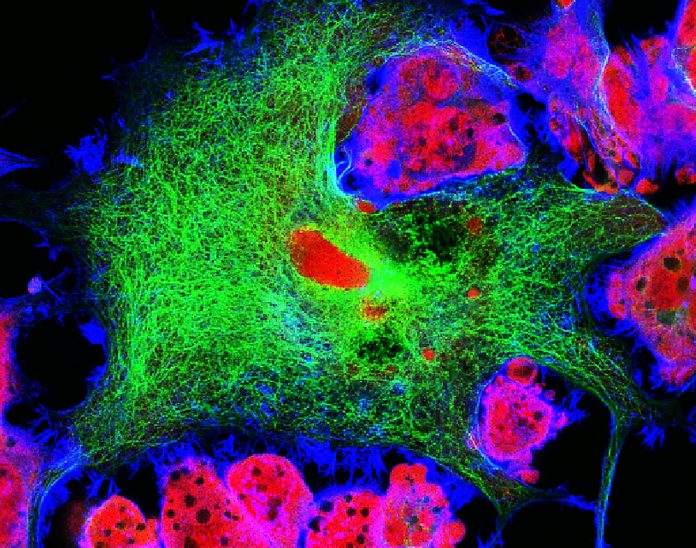
The gene expression signature differentiated between the two neuroblastoma cell types—the poor and regular prognosis—in all cases. The scientists also found the two cell types had distinct cellular shapes, internal spatial organization, and behaviors.
With the marker identified and validated, the group created additional in vitro models and new cell lines from xenografts derived from patient samples that had varying proportions of mesenchymal to adrenergic cells. Those models are available upon request through the CSTN, giving researchers a resource that could reinvigorate investigations into high-risk disease. Those tools may help scientists better understand tumor cell states, identify vulnerabilities and evaluate potential treatment strategies.
The St. Jude’s team has many more questions they want to answer, Patel, said. These include what the relationship is between adrenergic and mesenchymal malignant cells in the tumor, what determines whether a cell switches state, and how that impacts the cell’s progress.
“With this new gene expression signature for mesenchymal cells in neuroblastoma, we can dig into why outcomes are so varied between different children with this cancer,” said co-corresponding author Michael Dyer, PhD, St. Jude Department of Developmental Neurobiology chair.
“Using this dataset as our foundation, the field is poised to explore the biology of this pediatric cancer more deeply, and ultimately, move us toward improving our patients’ outcomes,” said co-corresponding author Elizabeth Stewart, MD, St. Jude Department of Oncology.