





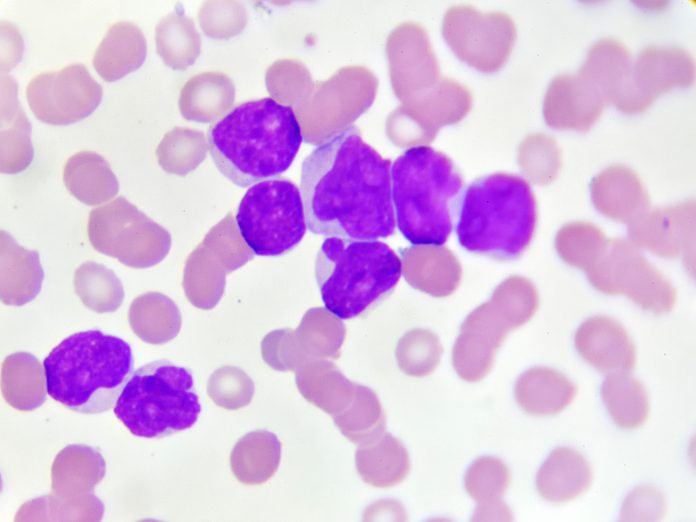
Researchers at the University of California San Diego have found that acute myeloid leukemia (AML) cells resist proteasome inhibitor drugs by activating a backup survival pathway. This knowledge allowed them to devise a combination of two drugs that can dismantle this resistance mechanism, slowing down the growth and expansion of AML cells. These findings were published today in the journal Blood.
Proteasome inhibitors are a class of drugs that target the waste disposal system of the cells responsible for clearing out proteins that are no longer needed. To sustain their rapid growth, cancer cells require high levels of protein turnover, and therefore disrupting proteasome activity can halt their spread. However, while these drugs are routinely used as a frontline treatment for multiple myeloma, they remain ineffective against other cancers including AML. Until now, scientists didn’t know the reason why.
“Imagine you’re driving down the highway and you hit construction, you just take an alternate route,” said Robert Signer, PhD, associate professor in the division of regenerative medicine at the University of California San Diego School of Medicine, deputy director of the Sanford Stem Cell Institute’s Discovery Center, and senior author of the study. “When AML cells hit the ‘construction’ of proteasome inhibitors, they do the same thing by rewiring their network to take an off-ramp and continue their way. Multiple myeloma, on the other hand, remains stuck in traffic and becomes a sitting duck.”
Signer and colleagues found that AML cells treated with bortezomib, a proteasome inhibitor drug, responded by activating the heat shock factor 1 (HSF1) gene. In turn, this gene increased the activity of a backup waste disposal mediated by lysosomes that is known as autophagy, compensating for the reduction in proteasome activity.
In human cells and in mice, inactivating the HSF1 gene made cancer cells responsive to bortezomib. A combination treatment consisting of bortezomib and Lys05, an autophagy inhibitor drug, was successful at inhibiting AML cell growth and extending the survival of mice.
This discovery could pave the way for an alternative therapeutic approach against AML, a disease known for being particularly difficult to treat. Among the treatments currently available to AML patients are chemotherapy, which can be highly toxic, and targeted therapies that are effective only on a small portion of patients carrying certain genetic mutations.
“Because AML involves so many potential gene mutations, it has made developing therapies quite difficult,” said Kentson Lam, MD, PhD, assistant clinical professor of medicine at the University of California San Diego School of Medicine and first author of the study. “When therapies targeting specific gene mutations are successful, they only benefit the small subset of patients whose cancer carries those specific mutations. We wanted to help more patients by making this attack more mutation-agnostic. We tested this approach across a variety of AML cell lines and patient samples, and it worked across nearly all of them, regardless of their mutations.”
The researchers plan to continue looking for drugs that could disable the backup survival pathways used by AML cells to resist treatment, with the goal of identifying promising combinations to take into clinical trials.
“Targeting these protein pathways is a new approach to cancer treatment,” said Signer. “Our hope is that this new research will improve treatment options for a wide range of AML patients.”