




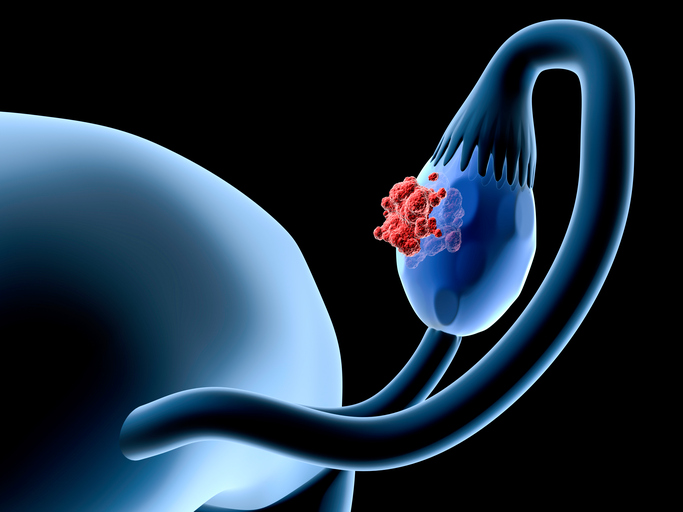
British Canadian biotech Epitopea has begun a Phase I/Ib trial of its off-the-shelf messenger (m)RNA cancer vaccine, CryptiVax-1001, for treating women with advanced high-grade serous ovarian cancer.
The OVACT trial plans to recruit up to 30 women with this type of cancer in the U.K. to take part in the study, which will look at safety and tolerability of the vaccine, as well as early signs of efficacy.
The trial will target advanced high-grade serous ovarian cancer that is homologous recombination-proficient and does not have cancer-linked BRCA mutations. These cancers retain a particular DNA-repair capability, but generally benefit less from PARP inhibitors, an important class of maintenance treatments used to delay ovarian cancer progression.
Founded in 2021, Epitopea operates in Cambridge and Montreal, building on research by University of Montreal scientists Claude Perreault, MD, and Pierre Thibault, PhD, who combine genetic analysis with mass spectrometry to identify previously overlooked molecular targets on cancer cells.
“Our scientific founders at the University of Montreal identified that the main source of tumor presented antigens by which T cells recognize cancer cells was the cryptic or dark genome. The 98% of the human genome that we have largely ignored in generating therapeutics,” Alan Rigby, PhD, CEO of Epitopea, told Inside Precision Medicine.
“In addition to their tumor specificity, these antigens exhibit significant sharing across patients diagnosed with the same tumor type and many were shown to be immunogenic with their presentation correlated to and associated with progression. The company was formed to take advantage of this unique class of aberrantly expressed tumor specific antigens (aeTSAs) or ‘Cryptigens’ via the development of therapeutic mRNA vaccines capable of priming a strong and broad immune response.”
Epitopea raised $31 million in October 2024, bringing its total disclosed funding above $45 million, with investors including Advent Life Sciences and Cambridge Innovation Capital. It also announced a licensing deal with Merck & Co. last year to identify new tumor-specific targets.
The OVACT trial is the first time Epitopea has tested any of its technology in human trials. “Epitopea’s vaccine is designed to work in a very similar manner to the COVID-19 vaccine that many are very familiar with … it is injected into the muscle of treated patients, the LNP encapsulated mRNA then migrates to lymph nodes and primes a T cell response that should be capable of recognizing the tumor,” says Rigby.
“The difference is that our vaccine targets shared tumor-specific antigens that are verified to be presented only on a patient’s tumor and thus invokes a T cell response only to the tumor.”
A key difference between Epitopea’s therapeutic vaccine and some others being developed is that it is intended to treat a group of patients rather than being an individualized therapy as the antigens being targeted by the vaccine are shared by patients with a similar tumor subtype.
“Compared to personalized vaccines … development costs for making clinical trial material is much lower,” explains Rigby. “Perhaps more important than the significant reduction in the cost-of-goods is the absence of any treatment delay given there is no needle-to-needle delay from biopsy to vaccine build, which is currently ~65 days, during which some patients tumors will have progressed.”
Of course the main focus of a first-in-human study is monitoring patient safety and checking for potential side effects such as excessive immune reactions to the therapy. “We put substantial effort into selecting antigens whose expression is restricted to the cancer cells, with the aim of directing the immune response towards tumor cells while minimizing the risk of attacking healthy tissues,” notes Rigby.
However, it remains to be seen how effective this approach will be. If successful, a shared-antigen vaccine could offer a more scalable alternative to individually tailored products. Epitopea’s choice of homologous recombination-proficient ovarian cancer also addresses a population with relatively limited benefit from existing biomarker-directed maintenance therapies after platinum chemotherapy has failed.
“Ultimately, the important question is whether vaccination can delay recurrence and improve long term patient outcomes. Demonstrating this will require appropriately designed subsequent trials including randomized studies; as an immune response alone is not enough,” concludes Rigby.