





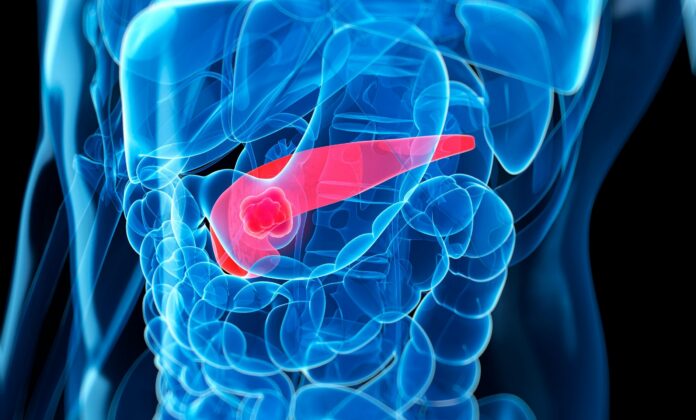
An experimental blood test detected nearly 87% of early-stage pancreatic cancers and showed the potential to identify high-risk precancerous lesions, raising the possibility that liquid biopsy could eventually help physicians intervene before pancreatic cancer becomes invasive.
The test, called PANXEON, combines a 13-microRNA signature with the established tumor marker CA19-9. In a large international study, it detected 86.8% of stage I and II pancreatic ductal adenocarcinomas (PDAC). Perhaps more notably, it identified 64.3% of high-grade dysplasia in patients with high-risk pancreatic cysts.
The findings, published in Nature Medicine, suggest a possible role for blood-based molecular testing in surveillance of people already at elevated risk for PDAC, rather than screening the general population.
“The real opportunity here is not simply to find pancreatic cancer earlier,” senior author Ajay Goel, PhD, AGAF, of City of Hope, told Inside Precision Medicine. “It is to determine whether molecular surveillance can eventually help us identify the disease while it is still curable, or even intercept it before invasive cancer develops.”
PDAC remains one of the deadliest cancers, largely because most tumors are discovered after curative treatment is no longer possible. Current surveillance of people at increased risk relies primarily on MRI and endoscopic ultrasound, which can be costly, burdensome, and imperfect at detecting small pancreatic lesions. Goel and colleagues developed PANXEON—short for PANcreatic cancer eXosome Early detectiON—as a potential noninvasive complement to those approaches.
The study initially included 1,785 patients recruited at 12 institutions in the United States, Japan, Italy, and South Korea. After samples with inadequate RNA quality were excluded, investigators analyzed 1,757 plasma samples from 1,649 patients across training, validation, independent testing, treatment-monitoring, and cross-reactivity cohorts.
PANXEON builds on a signature of 13 microRNAs, small noncoding RNA molecules that can reflect biological changes associated with cancer. Five of the markers circulate freely in plasma, while eight are carried within exosomes, small membrane-bound vesicles released by cells. Researchers used an XGBoost machine-learning model to analyze the miRNA signature and then combined it with CA19-9.
“Our hypothesis was that combining cell-free and exosomal microRNAs would give us a broader molecular view of what is happening in the pancreas than either compartment alone,” Goel said.
On its own, the miRNA signature distinguished patients with early-stage pancreatic cancer from those without the disease with high accuracy, achieving an AUROC—a measure of how well a test distinguishes between people with and without a disease—of 88.6%. It detected 83.8% of stage I and II cancers. When researchers combined the miRNA signature with CA19-9 to create PANXEON, the detection rate increased to 86.8%.
The test also showed relatively little cross-reactivity with other gastrointestinal cancers, and the miRNA signature performed consistently across tumor locations, countries, ethnicities, and risk levels among controls.
But the results also illustrate one of the central challenges facing early cancer detection tests: maintaining specificity in the patients most likely to receive them.
PANXEON had a false-positive rate of just 3.2% among low-risk controls, but that rose to 15.6% among high-risk controls. Goel said people with pancreatic cysts, chronic inflammation, inherited susceptibility, and other pancreatic abnormalities may have molecular changes that overlap with those found in neoplasia.
“A positive PANXEON result should not be interpreted as a diagnosis of pancreatic cancer and certainly should not, by itself, lead to surgery,” he said. “I would view it as a risk signal.”
Such a signal could eventually help determine which high-risk patients should undergo more careful MRI or EUS, multidisciplinary evaluation, or shorter-interval surveillance.
“At least initially, I see its primary role as complementing rather than replacing MRI or endoscopic ultrasound,” Goel said.
The finding in high-grade dysplasia may point toward an even earlier opportunity. PANXEON detected 64.3% of these advanced precancerous lesions while remaining negative in 75.5% of pancreatic cysts without high-grade dysplasia. The miRNA component, rather than CA19-9, appeared to drive much of the signal in these pre-invasive lesions.
“That suggests molecular alterations associated with advanced neoplasia may already be detectable in the circulation before an invasive cancer is present,” Goel said.
However, he cautioned that the high-grade dysplasia cohort was small and included patients who underwent surgery for clinically concerning cysts. The study therefore cannot establish that a positive PANXEON result identifies a lesion that will progress to cancer.
The researchers also found that the miRNA signature changed with disease status. Levels declined during neoadjuvant chemotherapy and following surgery and rose before disease recurrence, suggesting possible applications in treatment monitoring or recurrence detection. The authors stressed, however, that the study was not designed to establish PANXEON as a minimal residual disease or recurrence assay.
Other limitations included age differences between PDAC patients and some controls, limited representation of Hispanic and African American patients, and the inability to determine how long before clinical diagnosis the molecular signal becomes detectable.
The next critical step, Goel said, is prospective longitudinal testing in the populations for whom PANXEON is ultimately intended, including people with hereditary or familial risk and those with pancreatic cysts. Those studies will need to determine not only diagnostic accuracy but whether molecularly guided surveillance leads to more cancers being found while they remain resectable, fewer unnecessary procedures, and ultimately better outcomes.
“Perhaps the most exciting aspect is the detection of high-grade dysplasia,” Goel said. “If that finding is confirmed prospectively, the opportunity may extend beyond diagnosing pancreatic cancer earlier to intercepting the disease before invasive cancer develops.”