





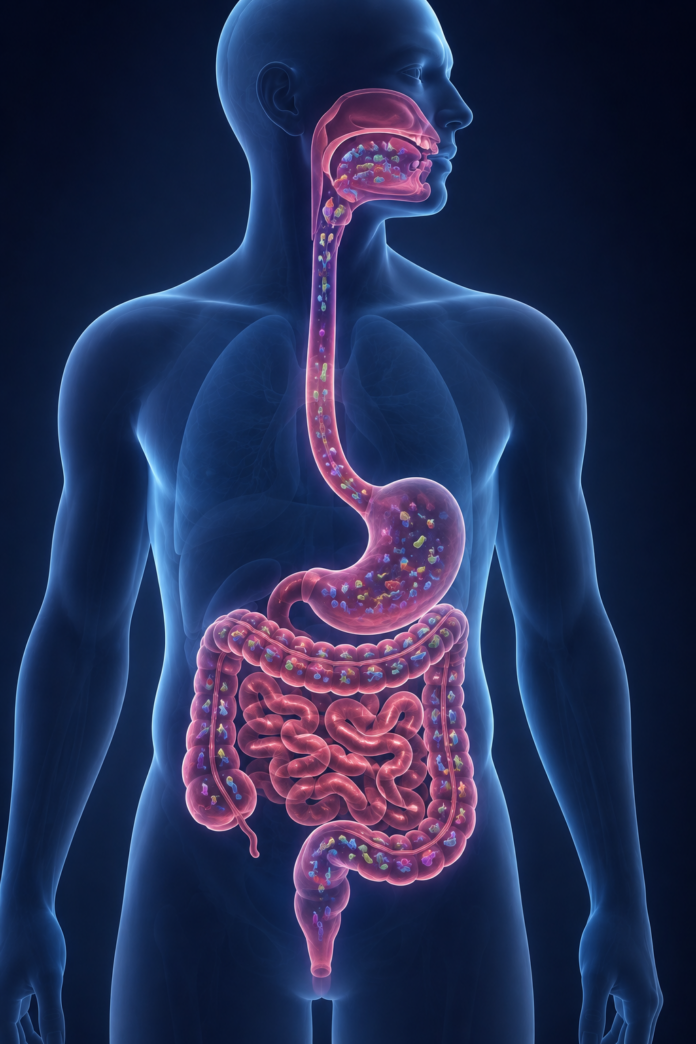
Researchers from Yonsei University in Seoul have shown that measuring mouth-to-gut microbial transmission patterns can distinguish patients with gastric or colorectal cancers from healthy people, potentially offering a less-invasive method for gastrointestinal cancer diagnosis and risk stratification.
“While it has long been known that oral microbes can occasionally be found in the gut, this study is significant because it transformed that phenomenon into a quantitative, individual-level metric and, for the first time, linked it to predictive models capable of distinguishing gastric and colorectal cancers,” co-first author Lae-Guen Jang, PhD, a postdoctoral researcher at Yonsei University, told Inside Precision Medicine. “This demonstrates the clinical potential of oral-gut microbial transmission.”
Writing in Cell Host & Microbe, Jang and colleagues explain that under healthy conditions, oral bacteria rarely colonize the gut due to protective barriers like salivary antimicrobial peptides, gastric acids, and competition from resident gut microbiota. However, inflammation and immune dysregulation can compromise these protective mechanisms, allowing oral microbes to become established in the gut, exacerbating inflammatory conditions.
For the study, the researchers used 16S ribosomal RNA sequencing to analyze paired oral and fecal samples from 77 people with treatment-naïve gastric cancer, 86 with treatment-naïve colorectal cancer, 215 with metabolic disorders, and 129 healthy controls.
They then created a mouth-to-feces (MF) index, which measures the extent to which identical microbial sequence variants are found in oral and fecal samples from the same person.
“A key achievement of this study is the precise tracking of mouth-to-gut microbial transmission through high-resolution analysis at the single-sequence level,” said Ji-Won Huh, PhD, assistant professor at Chungnam National University, who co-led analyses of oral-tumor-fecal microbial associations. “This allowed us to identify subtle diagnostic signals that might be overlooked by conventional species- or genus-level analyses.”
The MF index revealed elevated mouth-to-gut transmission in patients with cancer as well as different signatures between people with gastric or colorectal cancer, which varied further according to disease severity.
Specifically, patients with gastric cancer exhibited alterations in their oral microbiota, whereas those with colorectal cancer showed significant changes in their fecal microbiota. In addition, the MF index was a significant 2.6- to 3.0-fold higher in the patients with cancer relative to healthy controls.
“The presence of oral-associated bacteria in the gut of patients with cancer was not entirely unexpected,” said co-corresponding author Sun Ha Jee of Yonsei University. “What we had not fully anticipated was how the signal varied across disease groups, how much of it could be detected in oral samples alone, and how strongly it depended on the way microbial features were represented.”
The team also compared the signatures found in the cancer patients to results from fecal occult blood tests, a standard colorectal cancer screening tool that analyzes stool samples. They found that sensitivity was significantly higher with the oral samples than with the standard test, at 92.9% versus 61.0%.
Lead author Jihyun F. Kim of Yonsei University commented: “Being able to detect gastric and colorectal cancer-associated signals simply by rinsing the mouth has important implications for lowering barriers to cancer screening. Beyond gastric and colorectal cancers, this analytical framework can be expanded to a wide range of diseases and may ultimately contribute to personalized risk prediction by integrating genetic, lifestyle, and clinical information.”
The researchers caution, however, that prospective clinical studies are needed before the MF index could be used in practice. The team is also planning to analyze human genetic factors in relation to microbiota profiles.