





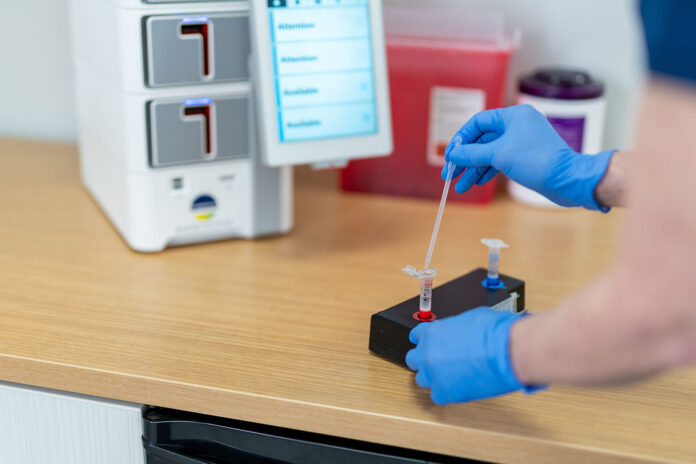
In the field of infectious diseases, rapid and precise diagnosis is important to ensure not only timely treatment, but effective surveillance as well. Although centralized laboratory-based testing offers excellent sensitivity and specificity, tests at the point of care (POC) allow healthcare providers to initiate prompt interventions like isolation and contact tracing, particularly in the setting of an epidemic.
Molecular POC tests bridge the gap between advanced diagnostics and POC settings. These tests are more sophisticated than immunoassay-style lateral flow devices and have sensitivities that often rival polymerase chain reaction (PCR), a gold-standard technique for most nucleic acid-based diagnostics. Like centralized nucleic acid amplification tests (NAAT), which include PCR, commercially available molecular POC diagnostics detect bacterial or viral DNA or RNA that can be amplified from trace amounts in various sample types.
But where lab-based NAAT often requires expensive equipment that needs to be used by trained personnel in specialized laboratories, molecular POC alternatives have fully automated “sample in–result out” systems designed to be used where they are most needed by people who do not have clinical laboratory experience.
The first molecular POC diagnostics for infectious diseases became commercially available around 10 years ago. They were often based on NAAT for large analyzers designed for centralized laboratories.
Global healthcare and biotechnology companies like Abbott, bioMérieux, Cepheid, and Roche have miniaturized these tests to make them suitable for POC use, be it in urgent care facilities, pharmacies, elderly care homes, or even mobile clinics designed to reach patients in remote areas.
The importance of diagnostic stewardship
Diagnostic stewardship describes the process of ordering the right test for the right patient at the right time, which then leads to the right treatment. It complements the more well-known idea of antimicrobial stewardship, which is used to reduce unnecessary antibiotic use and fight the burgeoning problem of antimicrobial resistance.

Chief Medical Partner, VP
Roche Diagnostics
“I think the increased availability of molecular technology into the clinical diagnostic space has allowed us to evolve testing beyond the centralized lab and into the point-of-care space, with diagnostic stewardship the focus of that,” said Denise Heaney, PhD, chief medical partner and vice president of medical and scientific affairs at Roche Diagnostics.
“It’s important to point out that there are times and places for each type of test, but the real message is that being able to add technologies and innovate into this space allows us the ability to be better diagnostic stewards, which ultimately impacts patient care.
“That’s what molecular point of care testing is doing. It’s giving us more options to adjust our testing algorithms based upon who we need to test and when.”
Roche’s contribution to molecular POC testing is the cobas® liat (lab in a tube) system, a compact unit that brings gold-standard PCR technology to POC settings. It currently offers seven individual and multiplexed tests for respiratory tract infections (Streptococcus pyogenes [group A strep], SARS-CoV-2, influenza A/B, respiratory syncytial virus [RSV]); sexually transmitted infections [STIs; Chlamydia trachomatis, Neisseria gonorrhoeae, Mycoplasma genitalium]; and Clostridioides difficile.
“Most liat assays can be completed in 15–20 minutes, making it a faster alternative to conventional PCR,” Heaney said, adding that the liat system’s sensitivity and specificity are comparable to those of centralized lab PCR assays. “It’s a misconception that if you have a faster test you need to sacrifice performance.”
The greater speed relative to conventional PCR comes down to the small size and the fact that the whole process is fully automated in one tube, explained Heaney. There is no need for pipetting, and the smaller surface area and volume allow for faster temperature changes during the thermal cycling steps of amplification.
The COVID-19 pandemic expedited the movement of liat systems to decentralized settings; there are currently around 10,000 units in use throughout the U.S. in places like urgent care and physician offices.
A case for in-pharmacy “test and treat”

Director, Abbott
Lack of accessible care is a key barrier to diagnostic stewardship and one that Abbott is helping to overcome with its ID NOWTM platform. “ID NOW was the first commercially available rapid molecular test,” said Norman Moore, PhD, director of scientific affairs and infectious diseases at Abbott. It is also among the fastest, providing results for each of its four detection tests (COVID-19, influenza A/B, RSV, Streptococcus pyogenes) in under 15 minutes.
The speed is achieved using isothermal amplification, specifically the nicking enzyme amplification reaction, instead of the thermal cycling used for PCR. The method creates short DNA amplicons by continuously regenerating a nicking site, allowing the polymerase to displace the strand and initiate new rounds of amplification.
The test came about after the H1N1 influenza A outbreak in 2009, when it became clear that a rapid, sensitive diagnostic solution was needed. “For flu treatment to be effective, it needs to be administered within 48 hours, so it was important to us to get closer to the patient,” said Moore.
“There are so many places across the U.S. without quick and easy access to a hospital, but there is usually a Walmart, Walgreens, or other pharmacy close by,” he added. “Pharmacies have antibiotics or antivirals on hand, so it’s very convenient for some consumers to use this one stop shop.”

The recently published Project IMPACT, which was financially supported by Abbott, highlighted multiple benefits associated with increasing access to “test and treat” at community pharmacies. The study sampled 15 community pharmacies that offered a test and treat service using ID NOW. In all, 330 tests were carried out, of which 71 were positive. Among those who tested positive, 26 were prescribed treatment and 23 were dispensed medication within a day of the positive test.
Most (85%) patients who tested positive did not seek additional care after their pharmacy-based test, and nearly 12% said that if they hadn’t received the test in the pharmacy, they would not have gone elsewhere to be tested. Furthermore, costs were much lower for in-pharmacy testing (e.g. ~$140 vs. $2,592 for testing in an emergency department), which benefits both patients and the broader healthcare system by improving efficiency and reducing financial strain.
However, Abbott notes that most private and public payers, including Medicare and Medicaid, currently offer limited coverage and reimbursement of pharmacy-based test and treat services. Addressing this could increase access to timely and cost-effective care for communities.
CRISPR-based POC testing
Cost is an important consideration and is often a significant barrier to healthcare access, and thus diagnostic stewardship, particularly in low- and middle-income countries. This has led researchers to explore different technologies for pathogen detection.
One tool that has emerged and shown transformative potential in the field of molecular diagnostics is the clustered regularly interspaced short palindromic repeats (CRISPR)-associated (Cas) enzyme system. It can also be cheaper than traditional nucleic acid diagnostic techniques, in part because the reagents are inexpensive to produce at scale and partly because the tests tend to use either a single isothermal amplification step or, in emerging formats, no amplification. This means there is no need for expensive hardware.
CRISPR-Cas technology was originally developed for gene editing but has been repurposed for POC diagnostic testing due to its high sensitivity, specificity, and ease of use. CRISPR-Cas systems recognize foreign nucleic acids through CRISPR RNA (crRNA), which guides Cas proteins to their nucleic acid targets. Importantly, this targeting mechanism is highly programmable and can be adapted to different pathogens by modifying crRNA sequences.
The two most well-known CRISPR-based POC diagnostic platforms are SHERLOCK (specific high sensitivity enzymatic reporter unLOCKing) and DETECTR (DNA endonuclease targeted CRISPR trans reporter).
SHERLOCK was developed in the laboratory of Feng Zhang, PhD, at the Broad Institute and relies on the RNA-targeting enzyme Cas13a to detect DNA or RNA sequences with extremely high sensitivity. When Cas13a binds its target, it activates collateral cleavage of nearby reporter molecules, generating a detectable signal that can be read via fluorescence or on a lateral-flow strip. SHERLOCK combines this CRISPR detection with isothermal recombinase polymerase amplification to allow rapid testing without a thermocycler. Both SHERLOCK and its successor SHERLOCKv2 have been used extensively for detecting viral and bacterial pathogens, and can even distinguish between Zika and dengue viruses.
In 2020, the Sherlock CRISPR SARS-CoV-2 kit became the first U.S. Food and Drug Administration (FDA)-approved CRISPR diagnostic when it received Emergency Use Authorization for laboratory-based testing. The test was produced by Broad Institute spin-out Sherlock Biosciences and has since been acquired by OraSure Technologies. OraSure has not marketed the CRISPR SARS-CoV-2 kit, but reported in a press release that Sherlock’s self-test for chlamydia and gonorrhea is in clinical trials and expected to be submitted to the FDA for review by the end of this year.
DETECTR works similarly to SHERLOCK, but uses Cas12a instead of Cas13a to target specific DNA sequences. Like SHERLOCK, DETECTR requires an amplification step, typically loop-mediated isothermal amplification. The platform was originally developed by Jennifer Doudna’s, PhD, group at University of California, Berkeley and is now overseen by spin-out company Mammoth Biosciences. It has been used to detect and differentiate human papillomavirus (HPV) genotypes and detect Mycobacterium tuberculosis and Plasmodium species. The test was also adapted for SARS-CoV-2 but is not commercially available through Mammoth Biosciences. Instead, the company has formed diagnostic partnerships with companies like Agilent Technologies, Merck, and VedaBio to develop and scale its CRISPR-based diagnostic tests.

Chief Scientist
CSIR–IGIB
Alongside these pioneers in the field, smaller companies are developing CRISPR-based diagnostics using various combinations of Cas enzymes, amplification technologies, and readout methods. One example of the versatility of the CRISPR-Cas system is FELUDA (FnCas9 editor linked uniform detection assay), developed by principal scientist Debojyoti Chakraborty, PhD, chief scientist Souvik Maiti, PhD, and colleagues at the Council of Scientific and Industrial Research–Institute of Genomics and Integrative Biology (CSIR–IGIB) in New Delhi, India.
Chakraborty and team were working with their patented version of Cas9 to detect sickle cell anemia mutations in saliva samples, when, at the start of the COVID-19 pandemic, they were asked to develop a test for SARS-CoV-2 in response to a lack of quantitative PCR machines available throughout the country. They easily changed the guide RNA to detect SARS-CoV-2 and combined the test with a reverse transcriptase PCR amplification reaction. They then created a mobile app that could read the lateral flow-based detection strip, and the test was used in hospitals and mobile laboratories in more remote regions.
“It was not so difficult to imagine and execute,” said Chakraborty. “The challenges arose during field application, where there are lots of variables.” Indeed, his team found that if the chemiluminescent test strips were not read within 5–10 minutes, oxidation of the particles would lead to false positives.
The test was commercialized by Tata Medical and Diagnostics as CSIR–IGIB is a government organization and was unable to manufacture it in house. Chakraborty said his team have made similar tests for Helicobacter pylori and rotavirus, which can be deadly in resource-limited areas like the foothills of the Himalayas. The rotavirus test has been validated in the laboratory and is going out to doctors where needed. “But again, we do not have any plans to make it commercial, we just want help the clinicians make an easier diagnosis than the current culture-based one. It’s almost like a community engagement,” Chakraborty remarked.
Expanding to syndromic testing
At present, most commercially available molecular POC diagnostic tests target individual or small groups of pathogens. Yet, syndromic testing—the concept of testing a single sample for multiple pathogens that cause similar symptoms—can improve diagnostic stewardship and cut costs compared with serial individual tests.
Unlike other companies, bioMérieux has specialized in syndromic testing. Across their BIOFIRE® range of molecular diagnostics, they cover over 170 targets from multiple syndromic panels. Within this range is BIOFIRE SPOTFIRE®—their POC platform—which launched in 2023 with a multiplex panel for 15 respiratory pathogens.

VP, R&D Molecular Biology
bioMérieux
“At bioMérieux, we design and develop diagnostic tools that meet the evolving needs of global markets, and in the U.S., it’s been clear for a while that there’s a strong trend toward the need for rapid diagnostic tests at the point of care,” said Amy Davis, PhD, vice president of R&D molecular biology at bioMérieux. “We had seen such a huge success of our syndromic BIOFIRE TORCH® system in the hospital setting and realized there was an unmet need for rapid and really comprehensive results in point-of-care.”
The SPOTFIRE system has an automated workflow that includes sample preparation, reverse transcription, and two stages of PCR followed by endpoint melting analysis, a feature that sets it apart from other tests and enables high sensitivity and specificity within 15–20 minutes.
“This is important for antimicrobial stewardship, because reliable results within 20 minutes can make the difference between a clinician needing to guess what the person has and prescribe antibiotics as a cautionary measure, or seeing that the report says influenza and prescribe an antiviral,’” Davis said.
She added that bioMérieux followed the respiratory panel with a sore throat addition and is planning new tests focused on women’s health and STIs “because these tests can be most impactful in the point of care.”
Meanwhile, Roche is expanding toward syndromic testing, with plans for an STI panel for genital lesions that will include herpes simplex viruses 1 and 2, syphilis, and varicella-zoster virus to complement their chlamydia and gonorrhea assays.
Removing the need for amplification
There are currently no CRISPR-based platforms that offer full syndromic testing, but VedaBio is hoping to change that with their CRISPR Cascade™ platform and a single-enzyme Cas system. Syndromic testing will not be the only feature that sets CRISPR Cascade apart from other CRISPR-based diagnostic tests—the system will be entirely amplification-free.

President & CEO
VedaBio
“In pursuing our mission to bring high medical value testing to the point of care, we eliminate amplification, and thus, eliminate compromise,” said Frédéric Sweeney, PhD, VedaBio’s president and CEO. “This allows us to combine accurate comprehensive testing with speed, affordability, and simplicity of assay design—a key challenge for PCR-based techniques—and offer exactly what urgent care and other decentralized settings have been waiting for.”
The cascade begins when ribonucleoprotein (RNP)-1 Cas recognizes the target sequence. Then, instead of a preamplification step, the test uses reporter molecules, blocked nucleic acid sequences, and a second enzyme, RNP-2 Cas, to catalyze the exponential cascade reaction that gives a result within 10 minutes.
The first assay in development is for respiratory infections, an obvious choice, said Sweeney, because there are “124 million patients every year in the U.S. alone that walk into urgent care with a respiratory infection.” There is potential to expand to other syndromic areas like STIs, gastrointestinal infections, and urinary tract infections.
To achieve these goals, VedaBio has complemented its internal intellectual property portfolio with a non-exclusive license agreement, and a close working relationship, with Mammoth Biosciences that will allow the company to simplify its assays and achieve clinically relevant sensitivity with a single-enzyme system. In September this year, VedaBio announced a Series A extension alongside a strategic agreement with Siemens Healthineers, worth up to $25 million, to further advance the CRISPR platform.
Internal data suggest that the test is “as sensitive as any molecular clinical sensitivity test that’s approved out there,” said Sweeney. He added that although there is no publicly available data yet, people should expect to see more information in the public domain next year and the test becoming available in the coming years.
Regardless of what the future holds in terms of molecular POC testing, Heaney summed it up well: “More options are always needed to achieve the initiatives that are set before us, especially if that’s eradicating transmission or reducing disease prevalence. It comes back to the continuum of care within the diagnostic stewardship of right test, right patient, right time, which will give us the right treatment.”
Laura Cowen is a freelance medical journalist who has been covering healthcare news for over 10 years. Her main specialties are oncology and diabetes, but she has written about subjects ranging from cardiology to ophthalmology and is particularly interested in infectious diseases and public health.