





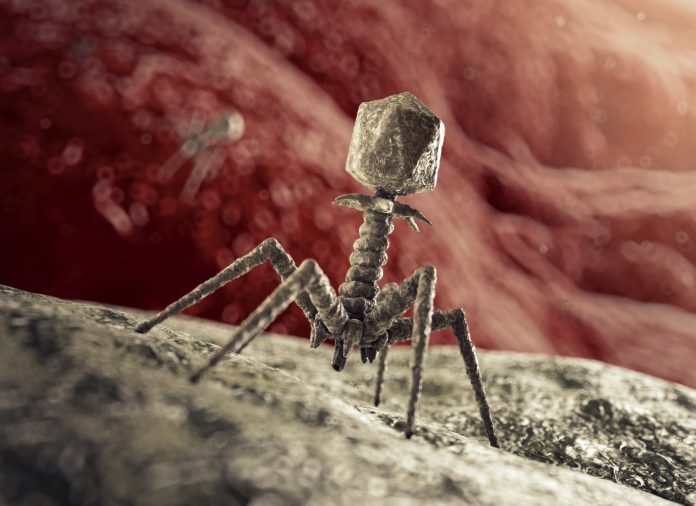
Researchers have engineered entirely synthetic viruses that can invade bacteria and could offer new pathways to fight infection.
The bacteriophages, described in the Proceedings of the National Academy of Sciences (PNAS), target mycobacteria which are responsible for diseases such as leprosy and tuberculosis (TB).
Manipulating the genetic code of these mycobacteriophages by removing undesirable genes and adding helpful genetic payloads could provide new ways of treating antibiotic-resistant infections.
By adding or subtracting genes, researchers can understand the genetics of these ancient viruses as never before and tailor their genomes to invade specific bacterial hosts.
“If a phage has 100 genes, does it need all 10? What happens if we remove this one or that one?” said researcher Graham Hatfull, PhD, from the University of Pittsburgh.
“We don’t have the answers to those questions, but now we can ask—and answer—almost any question we have about phages.”
Mycobacteria are among some of the worst human pathogens, with Mycobacterium tuberculosis responsible for more than 1.5 million deaths a year.
Although TB can be treated with multidrug regimens, antibiotic resistance is becoming widespread and new treatments are desperately needed.
There has been renewed interest in using phages to treat antibiotic-resistant bacterial infections, where their specificity compared to antibiotics offers benefits to preserving patient microbiomes.
However, their narrow ability to infect a particular host—be it in terms of genus, species or even strains within species—have impeded their usefulness.
The research team therefore synthetically constructed mycobacteriophages to improve their value as diagnostic and therapeutic agents.
Hatfull and co-workers reported being able to reconstruct the genome of whole phages using terminal deoxynucleotidyl transferase (TdT) chemistry, Golden Gate Assembly, and rebooting in Mycobacterium smegmatis.
TdT-based DNA synthesis generated phage DNA fragments between two and five kilo-base pairs (kbps) in length with a high proportion of guanine (G) and cytosine (C) nucleotides that could be readily assembled using Golden Gate Assembly and then rebooted in M. smegmatis.
The researchers maintain that the synthetic construction and manipulation of mycobacteriophages will greatly advance understanding of mycobacteriophages, including gene functions, structures, life cycles, gene expression, and regulation.
Although whole phage genome synthesis currently is relatively costly at around US$10,000 for a 50 kbp genome, they predict this is likely to rapidly become less expensive.
They believe: “The almost unlimited potential for design, construction, and rebooting will be transformative for understanding mycobacteriophages and for maximizing their therapeutic potential.”