





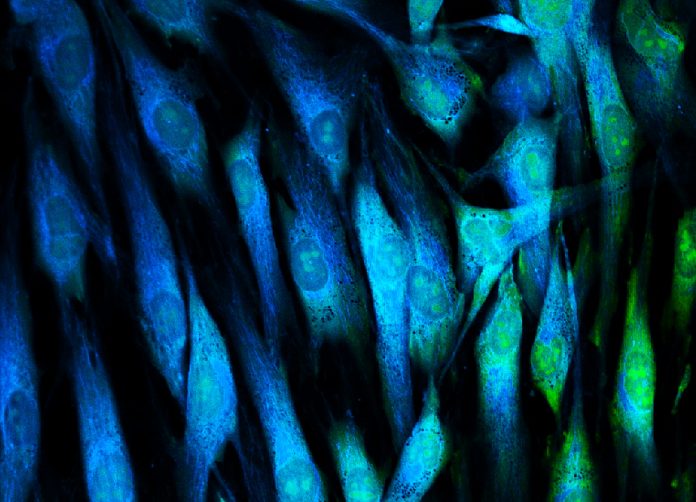
Researchers at the Wellcome Sanger Institute, the University of Cambridge, and the University of Newcastle in the U.K. have mapped human skin fibroblasts as part of the international Human Cell Atlas consortium. Their research revealed several fibroblast subtypes involved in multiple diseases, including acne, psoriasis, rheumatoid arthritis, and inflammatory bowel disease. This presents fibroblasts as potential drug targets for the first time.
Fibroblasts are scaffolding cells in the skin and other organs that are responsible for shaping the architecture and cellular microenvironment of different tissues. They play a role in wound healing, tissue repair, scarring, connective tissue formation, and maintenance of the skin.
Due to their involvement in scarring and inflammation, understanding the diversity of fibroblasts and their location in healthy and diseased tissue could provide ample clinical opportunities.
However, their heterogeneous nature, a lack of unique surface markers, and difficulties growing them in culture have made the study of fibroblast subtypes challenging in the past. Now, modern technologies, such as single-cell RNA sequencing and spatial transcriptomics, make the analysis of fibroblast heterogeneity in human tissues possible.
In their study, published in the journal Nature Immunology and titled “A Single-Cell and Spatial Genomics Atlas of Human Skin Fibroblasts Reveals Shared Disease-Related Fibroblast Subtypes Across Tissues,” the researchers used these technologies to map human skin fibroblasts from healthy skin samples and across 23 skin conditions, including lupus, psoriasis, acne, and skin cancer.
“Fibroblasts have critical roles in recruiting immune cells to skin tissue and causing scarring, which can result in a range of skin diseases,” said first author Lloyd Steele, PhD, of the Wellcome Sanger Institute and the University of Cambridge.
“We lack highly effective treatments to treat scarring in clinical practice, partly because these cells have been poorly understood. Modern technologies now allow us to begin to understand these critical cells in unprecedented detail. We’ve shown for the first time that fibroblasts occupy and maintain distinct anatomical microenvironments in skin tissue in health and disease.”
The research team wanted to gain a better understanding of the composition and function of fibroblast subtypes in human skin, how these states change across several diseases, and how these fibroblast subtypes relate to other human tissues.
To achieve this, the researchers processed and analyzed 2.1 million cells from RNA sequencing data of adult human skin, comprising 32 datasets and 251 donors. After quality control, the researchers were left with 357,276 high-quality fibroblasts.
Using these, the researchers then generated spatial transcriptomic data, which maps how gene expression varies across different locations within a tissue. This enabled the researchers to spatially map identified fibroblast subtypes in both healthy and diseased human skin.
Based on differential gene expression, the researchers identified six major fibroblast subtypes in healthy skin, located in distinct “tissue neighborhoods” and associated with specific functions.
Next, the researchers wanted to identify how fibroblast states changed in diseased skin. They therefore studied fibroblasts and their “tissue neighborhoods” in other organs, such as the endometrium, lungs, and intestines, with 14 diseases, including lung cancer, inflammatory bowel disease, and rheumatoid arthritis.
With the help of a deep-learning model, called scPoli61, the researchers compared fibroblasts from skin diseases with the previously identified healthy fibroblast subtypes. This allowed them to discover three fibroblast subtypes that are disease-specific and present in different organs across multiple diseases.
The study results mean that the researchers were able to identify potential universal drug targets, showing that there is a possibility in the future to develop single drugs that could work across several diseases in the body.
“The clinical relevance of our work is huge—it is paradigm-shifting in terms of how we move from understanding the role of individual cell types to uncovering how disease-specific cell types form ‘tissue neighborhoods’ that mediate inflammation,” explained lead author Muzz Haniffa, PhD, head of cellular genomics at the Wellcome Sanger Institute and professor of dermatology and immunology at Newcastle University.
“We find the same disease-related fibroblasts involved in several diseases across the body—atopic eczema, inflammatory bowel disease, rheumatoid arthritis—meaning we could find universal therapeutic targets in these cells to treat many diseases. This could save time and money in drug development, and reduce side effects for patients.”