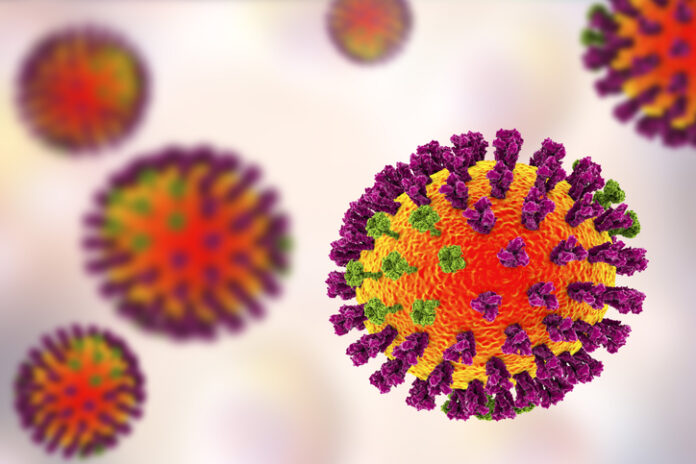
University of Michigan researchers have developed a new way to exploit a decades-old target in the quest for a universal flu vaccine, using baker’s yeast to produce virus-like particles displaying full-length M2, a highly conserved influenza protein.
In mice, the experimental vaccine generated antibodies that recognized M2 from five influenza strains and provided 100% protection when animals were challenged with three different strains. The findings were presented August 24 at the American Chemical Society Fall 2026 meeting in Chicago.
M2 has long attracted interest as a potential target for broadly protective influenza vaccines. Unlike hemagglutinin (HA), the abundant surface protein targeted by most current flu vaccines, M2 changes relatively little among influenza A viruses. Researchers have investigated vaccines targeting M2—particularly its extracellular domain, M2e—for more than 25 years, including in early clinical studies.
The Michigan team took a different approach, creating virus-like particles (VLPs) that densely display full-length M2. According to the researchers, this is the first time full-length M2 VLPs have been produced using baker’s yeast, Saccharomyces cerevisiae, and shown to generate M2-specific antibodies and protect mice against different influenza subtypes.
The strategy is intended to overcome a challenge that has complicated M2 vaccine development: although the protein is highly conserved, relatively little M2 is present on the surface of influenza viruses, so it does not naturally provoke the strong immune response generated against HA. Packing M2 onto VLPs makes the protein more visible to the immune system. The particles resemble influenza viruses in size and shape but contain no viral genetic material and cannot cause infection.
First author Trang Hoang, a University of Michigan doctoral student in chemical engineering, genetically engineered baker’s yeast to produce large amounts of M2. She then removed the yeast’s rigid cell wall, allowing M2-bearing VLPs approximately 100 to 200 nanometers in size to bud from the cell membrane for collection and purification.
Eighteen mice received the purified VLPs. Their serum contained abundant antibodies recognizing M2 from five influenza strains. When vaccinated animals were subsequently challenged with three of those strains, all were protected from infection.
The yeast-based manufacturing platform could offer another advantage. The researchers estimate that large quantities of vaccine could be produced in about a month, compared with roughly six months for conventional egg-based influenza vaccine manufacturing.
Fei Wen, PhD, U-M professor of chemical engineering and senior author, said the team expects an M2-directed vaccine to provide broader and longer-lasting protection than HA-focused vaccines, although the durability of immunity remains unknown.
The technology has been licensed for development as an oral vaccine. Researchers next plan to determine how long protection persists in mice and explore vaccine designs for people with weaker immune responses.
The findings remain preclinical, and previous M2-based vaccine strategies have faced challenges generating sufficiently strong and durable immunity. But the combination of full-length M2 presentation and rapid yeast-based manufacturing offers a new approach to an established target in the long-running effort to develop a broadly protective influenza vaccine.