





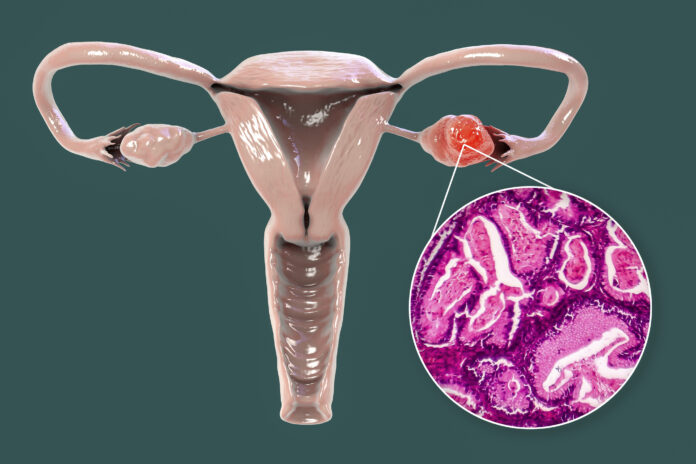
Researchers at University of Sydney’s NHMRC Clinical Trials Centre, RMIT University, and WEHI in Australia have developed a diagnostics blood test that could improve deciding which ovarian cancer patients should receive a PARP inhibitor. The test was developed during a four-year clinical trial conducted across 15 Australian hospitals, called SOLACE2 trial, while the researchers were investigating whether immune system “priming” could enhance the effectiveness of PARP inhibitor therapy.
The blood-based test, detailed in Nature Communications, measures immune biomarkers that signal the readiness of the immune system to recognize and attack cancer cells, and is potentially more accurate than using a DNA-based homologous recombination deficiency (HRD) test used, which is currently routinely used to determine eligibility for PARP inhibitor treatment.
PARP inhibitors are known to be most effective for treating homologous recombination deficiency (HRD-positive) ovarian cancer, where tumor cells cannot properly repair DNA breaks. Women whose tumors have not lost their DNA repair capacity, called HRD-negative ovarian cancer, are usually less responsive to PARP inhibitors. But evidence also shows that some some HRD-positive patients don’t respond treatment, while some HRD-negative patients do benefit, anomalies which show the shortcomings of current testing methods.
The new blood-based diagnostic also has the advantage of being non-invasive. Current HRD testing requires samples from the ovarian tumor and genetic analysis. “Our test focused on a real-time blood immune response rather than on the DNA repair capability of the cancer, which may no longer be accurate,” said senior study author Magdalena Plebanski, PhD, distinguished professor at RMIT University. “In doing so, we more accurately identified which SOLACE2 patients would most benefit from PARP inhibitor therapy.”
The new diagnostic, called the CUP-CC assay, analyzes a set of immune biomarkers in blood, including up-regulation of the chemokine receptor CCR4, and circulating levels of chemokines CCL17 and CCL22 and cytokines IL-6 and IL-8. The resulting biomarker signature shows the immune system’s ability to allow effector T cells to migrate to the tumors where they can fight the cancer. Data from SOLACE2 showed that patients with a CUP-CC-positive immune signature had much longer progression-free survival (PFS)—49.6 weeks compared with CUP-CC-negative patients who had median survival of 23.4 weeks.
This signature sprung from the SOLACE2 trial, which was looking for ways to prime the immune system to make PARP inhibitors more effective. Participants in the trial with platinum-sensitive recurrent ovarian cancer were assigned to one of three arms: olaparib monotherapy, olaparib with immune priming using cyclophosphamide, or olaparib followed by combination therapy with durvalumab (an immune checkpoint inhibitor). While none of the priming arms met the pre-specified threshold for efficacy, patients who were CUP-CC-positive, regardless of HRD status, consistently achieved longer PFS.
“These consistent findings across all treatment arms, and in both HRD and HRP subpopulations, is unexpected since the CUP assay was designed to evaluate immune reactivity to an analogue of cyclophosphamide, not a PARPi,” the researchers wrote.
HRD and HRP classifications have been based on genomic scar tests that measure both current and prior damage to DNA. But their inconsistency in predicting treatment response is likely due to these tests not reflecting acquired resistance or changes in DNA repair capacity over time. The researchers said that the CUP-CC assay could characterize a tumor’s current HRD-like immune environment, providing a dynamic measure of PARP inhibitor sensitivity.
Next steps for the researchers are to validate the CUP-CC assay across larger, independent clinical trial datasets and to compare its predictive power against existing HRD tissue tests. Future studies will evaluate the assay in maintenance therapy settings, including PARP inhibitor versus placebo trials, and in combination regimens such as PARP inhibitor–immunotherapy and PARP inhibitor with bevacizumab. The researchers are also investigating whether changes in CUP-CC status over time can predict the development of drug resistance.


