




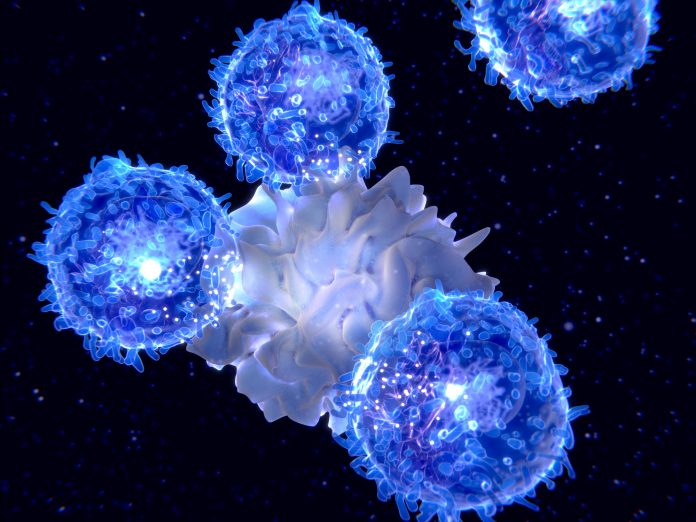
A new cancer immunotherapy strategy aims to turn an abundant laboratory-grown cell source into a personalized teacher for the immune system—showing a patient’s T cells not just one tumor target, but potentially the full array of targets displayed by that patient’s cancer.
Researchers at the University of California, San Francisco (UCSF) developed a dendritic-cell platform that combines the advantages of off-the-shelf cell therapy with the specificity of personalized cancer treatment. They generated dendritic cells from induced pluripotent stem cells (iPSCs), engineered them to avoid immune rejection, and transferred membrane material from an individual patient’s tumor onto their surface. The result was a renewable source of immune cells carrying a broad collection of that patient’s tumor targets. In experiments using leukemia and ovarian cancer samples, the cells activated patient T cells that killed matching tumor cells; the approach also suppressed tumor growth in humanized mice.
The study, published in Cell Stem Cell, suggests a potential way around two persistent challenges in cell-based cancer immunotherapy: producing enough consistent, high-quality immune cells and identifying the right tumor antigens to target.
“We’ve basically taken an allogeneic product and made it pretty much an autologous product,” senior author Robert Blelloch, MD, PhD, professor in the UCSF Department of Urology, told Inside Precision Medicine.
Creating a renewable source of dendritic cells
Dendritic cells play a central role in directing immune responses, presenting antigens to T cells while supplying additional signals that help determine whether those T cells should attack. But obtaining sufficient numbers of functional dendritic cells from individual patients can be challenging.
The UCSF team instead started with iPSCs, which can be expanded extensively and differentiated into dendritic cells. “The huge advantage, I think, of our system is here we have a very standardized approach,” Blelloch said. “Because we’re starting with iPS cells, we can make unlimited numbers of cells, and we can make it the same way every time.”
Because the iPSCs came from an unrelated donor, dendritic cells derived from them would carry donor MHC molecules that could identify the cells as foreign and trigger their rejection by the patient’s immune system. The researchers therefore genetically engineered the iPSCs to eliminate their endogenous MHC class I and II molecules, essentially removing a key part of their donor identity. But that solution created another problem: cells lacking MHC can become targets for natural killer (NK) cells, which recognize the absence of MHC as a danger signal.
The investigators addressed both problems by transferring tumor-derived membranes containing the patient’s own MHC-peptide complexes onto the engineered dendritic cells. The acquired MHC helped protect the cells from NK-cell killing while simultaneously supplying tumor antigens for presentation to T cells.
Giving T cells more targets
Rather than selecting a single tumor antigen, the strategy exposes T cells to a much broader collection of targets carried in the tumor-cell membrane.
“Here you’re putting the whole repertoire of all the antigens in,” Blelloch said.
That breadth could be important because tumors are heterogeneous and can evolve under treatment pressure. Therapies directed against a limited number of antigens can lose effectiveness if cancer cells stop displaying those targets.
The strategy also avoids the need to predict in advance which tumor antigens will generate the most useful immune response. Personalized cancer vaccines may require tumor sequencing and computational analysis to identify and select promising neoantigens. The new platform instead transfers a broad collection of tumor-derived MHC-peptide complexes directly to the dendritic cells.
“We can skip that step,” first author Huaigeng Xu, MD, PhD, said. “That’s most important, I would say.”
Engineering a stronger immune signal
Starting with iPSCs also allowed the researchers to modify the dendritic cells themselves. Dendritic cells naturally deliver both activating and inhibitory signals that help regulate immune responses. The investigators deleted PD-L1 and PD-L2 from the iPSCs, removing two checkpoint molecules that can restrain T-cell activity.
“We can manipulate that and say, ‘I’ll get rid of the stuff that’s trying to slow down the immune response,’” Blelloch said. “We can literally knock these molecules out.”
The team generated migratory dendritic cells expressing CCR7, a receptor that helps guide immune cells to lymph nodes. There, the dendritic cells can present tumor antigens to naïve T cells and help transform them into tumor-fighting effector cells. The envisioned clinical approach would be to administer the engineered cells under the skin, allowing them to enter the lymphatic system and reach lymph nodes.
“Once the T cells are primed to become effector T cells, then they would go back out into the system, travel all throughout the body of the patient, find the tumor cells and kill them,” Blelloch said.
Testing the strategy against human tumors
The researchers tested the approach using tumor samples and T cells from patients with leukemia and ovarian cancer. In laboratory experiments, the modified dendritic cells stimulated T cells that could recognize and kill patient-matched tumor cells.
They then tested the cells in humanized mice in two settings: priming the immune system before introducing tumor cells and treating animals after tumors had begun growing. Both approaches showed antitumor activity, but priming the immune response before tumor challenge was most promising.
“That was actually very effective,” Blelloch said. “That was more effective than waiting [for] the tumor to grow and then inject[ing] the dendritic cells.”
Targeting cancer before it returns
That finding has helped shape the researchers’ thinking about a possible first clinical use: patients who have undergone surgery but remain at high risk for recurrence.
a tumor removed during surgery could supply the membrane material needed to personalize the dendritic cells. Treatment could then be administered while tumor burden is minimal, with the aim of eliminating microscopic residual cancer before it develops into recurrent disease.
“Why not in that setting remove the cancer, use [material] from that cancer … and then put [the dendritic cells] in the patient, educate T cells to go kill all those remaining dormant cancer cells elsewhere in the body before they get a chance to regrow?” Blelloch said.
The platform remains preclinical. “But we really want to get this to patients,” Blelloch said. “That’s where we’re really putting a lot of effort right now.”